

The Hilarion Affair
Scandal, loyalty, and the collapse of a carefully built reputation

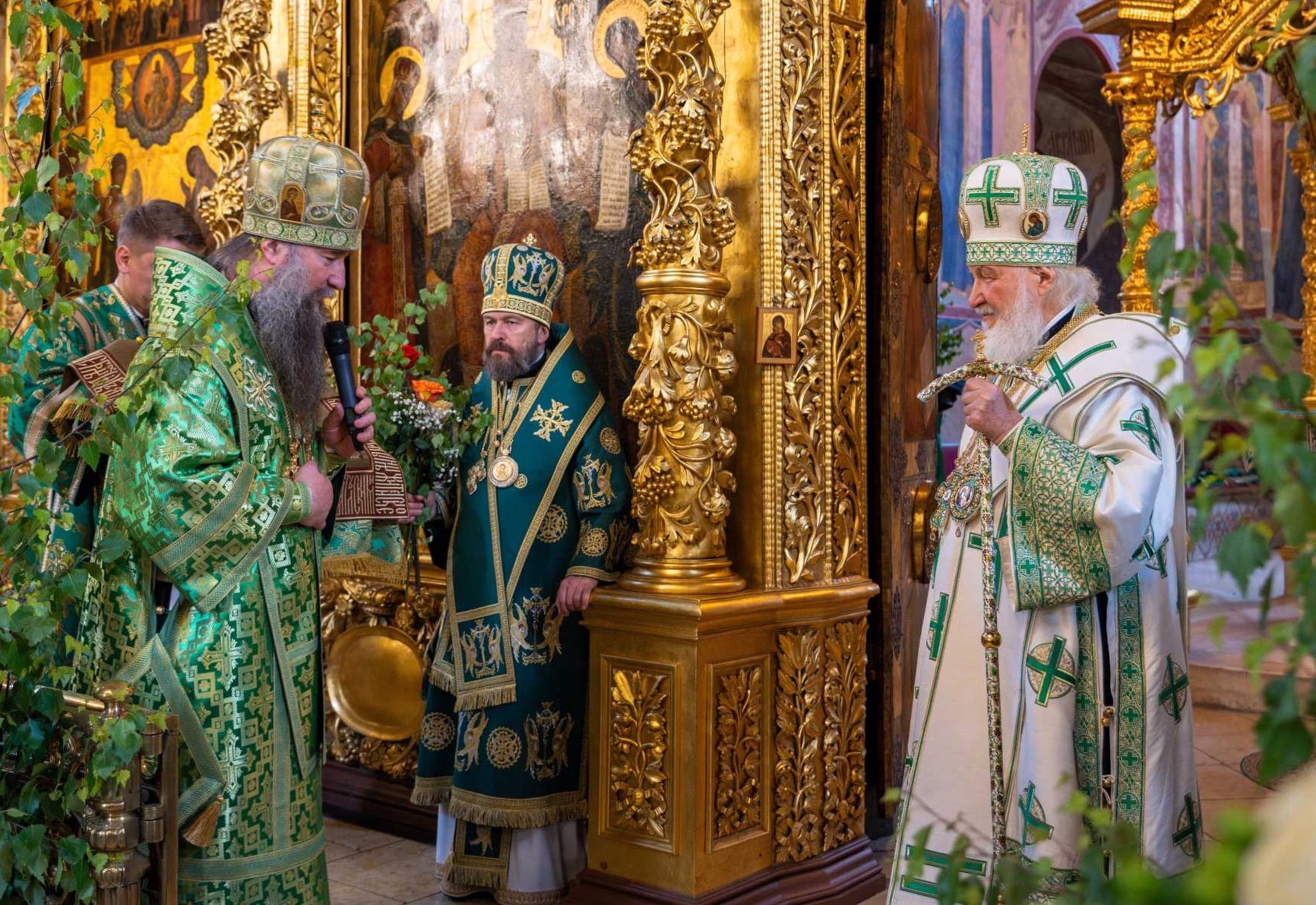
On Pentecost Sunday, May 31, Metropolitan Hilarion Alfeyev stood beside Patriarch Kirill at the Trinity-Sergius Lavra and concelebrated the Divine Liturgy. Less than a week earlier, he had been released from Czech custody without charges. The staging was deliberate, and the message unmistakable: whatever happened in western Bohemia, Moscow’s man had returned.
In his public statement after release, Hilarion offered thanks in a telling order: first God, then Patriarch Kirill, then the Russian Ministry of Foreign Affairs, personally Sergei Lavrov, personally Maria Zakharova, then the staff of the Russian embassy in Prague, his lawyer, and finally all those who had prayed for him. That sequence was his own. Read it again. The Russian state apparatus — Lavrov, Zakharova, the MFA — appears immediately after the Patriarch. This is not a trivial detail; it is a concise map of where Hilarion himself places his loyalties. Maria Zakharova, for her part, has become the public face of the most aggressive register of Russian diplomacy: a voice of calculated rudeness, official contempt, and habitual verbal bullying.
Forty-Eight Hours
The arrest took place on the afternoon of Sunday, May 24. Hilarion was released around midday on Tuesday, May 26 — about forty-eight hours in Czech custody, two nights. Not the years that Russian political prisoners spend behind bars across the country. Not the eighteen months that seminary graduates Popovich and Ivankovych have been held specifically in FSB Lefortovo without charges — a case I have written about at length. Hilarion called it "imprisonment" and compared himself to the Apostle Peter delivered from prison by an angel. The comparison is his to make. Others may note the scale. He did not spare a word for political prisoners in Russia — the self-portrait he offers is one of a man whose suffering crowds out everything else.
What does seem clear is that the circumstances of the arrest strongly suggest a setup. Czech police reported finding four small containers with a white substance in the trunk of his car after acting on an anonymous tip about possible drug possession. Hilarion’s own account adds important details: the car was stopped near a filling station, the trunk was searched, and three small packets plus a vial of white powder were allegedly found behind the trunk lining, in the compartment near the fire extinguisher, not in plain sight. He also says that the anonymous letter specified the exact time of departure from the church, the route, and the precise place where the substances would be found.
As Hilarion recounts it, the officer handling the powder wore no gloves, there was no video recording of the search, and no independent witnesses were present. In his and his lawyer’s reading, the anonymous letter could only have been written by someone who either placed the substances there or knew exactly who did. That remains their interpretation, not an established finding of the investigation. Still, the circumstances are suspicious enough that the explanation cannot simply be waved away.
The substance itself has been confirmed as prohibited under Czech law. What exactly it was has not yet been publicly disclosed, pending forensic analysis. That analysis is also expected to establish whether any fingerprints were present on the packaging. Hilarion has stated plainly that his fingerprints will not be found there.
The Embassy Detail
This is where the story becomes interesting in another way.
The Russian chargé d’affaires arrived at the police station the same day, accompanied by one embassy staff member. According to Hilarion, those two men — whom he identifies only as Valery Valerievich and Bogdan, without surnames — remained present throughout subsequent interrogations and stayed continuously with the detainees. He adds, almost casually, that these two men “constitute the full staff of the embassy” at present.
That absence of surnames is striking. Russian diplomatic personnel are usually identified by full name in formal settings. To refer to embassy officials only by first name and patronymic, while also stressing their uninterrupted presence during police questioning, is unusual. Whether that suggests anything about their actual institutional role cannot be proven from the available facts. But the pattern is familiar to anyone who has watched the Russian state operate abroad.
Who Ordered It — and Why
The Russian government reacted quickly and loudly. The Foreign Ministry described the arrest as a “deliberate, orchestrated provocation,” summoned the Czech chargé d’affaires in Moscow, and demanded explanations. The Russian Orthodox Church called it a “classic farce.” Within days, Hilarion was back in the Lavra. On the evidence now available, this does not look like a Moscow operation. Moscow behaved as though it had been caught off guard — and angered.
That points instead toward Czech actors: someone with access to security structures, advance knowledge of Hilarion’s movements, and a willingness to use both against a Russian hierarch. Nothing about the episode looks improvised. It required coordination.
One plausible hypothesis, though still unproven, concerns property. In recent years Hilarion’s operational base has been Karlovy Vary, home to the Saints Peter and Paul Cathedral, the Russian Orthodox church with golden onion domes that stands as one of the most visible symbols of Russian ecclesiastical presence in western Bohemia. If sufficient pressure were applied to drive Hilarion and his circle out of the Czech Republic, an immediate question would follow: what happens to that church? The most obvious institutional beneficiary of any confiscation or transfer would be the autocephalous Orthodox Church of the Czech Lands and Slovakia. That body is itself in a weakened state after a Prague court convicted former abbess Taťána Hanhur over the unauthorized transfer of monastery property valued at about $3.2 million. A weakened institution is often easier to manipulate than a healthy one.
The Suzuki Case
After his release, Hilarion left immediately for Hungary. He did not stay long in Czech territory — and in Hungary, it turns out, the situation is no better. The lawsuits continue, and by all indications he is losing them.
Hilarion’s conflict with George Suzuki, his former subdeacon, has produced two separate legal tracks: first, Hilarion’s own complaints against Suzuki, accusing him of theft and defamation; second, Suzuki’s defamation suit against Hilarion himself.
It is the second case that has now moved forward. According to Suzuki, the first hearing in his suit against Hilarion finally took place after more than a year and a half of procedural delay. At that hearing, the court reportedly explored the possibility of reconciliation — plainly put, whether Hilarion was prepared to acknowledge wrongdoing and ask forgiveness. He was not. Suzuki further reports that the court noted how difficult it would be for Hilarion’s side to maintain its accusations in light of police decisions to close the criminal case against Suzuki, lift the arrest warrant, and otherwise acknowledge the lack of grounds for prosecution. Once state authorities have effectively stepped back from the accusations, sustaining the same narrative in civil court becomes extraordinarily difficult.
Yet Hilarion has shown no sign of retreat. After two years of pursuing Suzuki through the press and the courts, he now finds himself, however briefly, in the position he once seemed eager to reserve for others.
A Longer Shadow
One further point should be stated plainly: it cannot be entirely excluded that Hilarion has some personal familiarity with narcotic substances. There is no direct evidence proving that at present, and the forensic record may eventually clarify the matter. But the broader ecclesiastical environment in which he has operated has not been untouched by drug-related scandal.
In 2020, Russian media reported that a drug laboratory had allegedly been found in the apartment of Bishop Flavian. Flavian later denied responsibility and claimed the laboratory was not really in his own apartment, but there are serious reasons to doubt the full credibility of that defense. What Radio Svoboda’s investigation established more convincingly is that the case quickly became entangled with pressure from the security services, including attempts to use a narcotics case as leverage against a hierarch viewed as insufficiently compliant. The point is not that every clerical scandal proves guilt. It is that the Russian Church’s moral theater and its lived institutional reality are often very far apart.
On the evidence currently available, the most probable reading remains this: someone in the Czech Republic, with the means and foreknowledge to do it, wanted Hilarion removed and used the available instruments to that end. The investigation has not yet revealed who that someone was.
What the affair has already revealed, however, is something about Hilarion himself. For years he cultivated the image of an intellectual, a theologian, a composer, and a diplomat of the Church. That symbolic capital has now been squandered. These episodes do not merely add one more blemish to his public image; they expose what was always underneath it — a career built on proximity to power rather than on the integrity that intellectual and theological distinction is supposed to guarantee. The former “foreign minister” of the Russian Orthodox Church now moves through a landscape of scandal, lawsuits, and diplomatic emergencies of his own making. His reputation is not just damaged.
At this point, it is collapsing beyond repair.
If the Suzuki affair, including the widely circulated video, has shown that Metropolitan Hilarion is gay, then why on those grounds alone has he not been removed from the episcopate? Surely this is incompatible with Orthodox teaching and expectations of a bishop? Regardless of whether it was blackmail or whatever else, the case revealed Hilarion living a lifestyle far removed from what it should be.
There is Hilarion the Great, there is Hilarion the New… And this one will enter the Synaxarion under the literal translation of his name — Hilarion the High, sorry, the Cheerful