


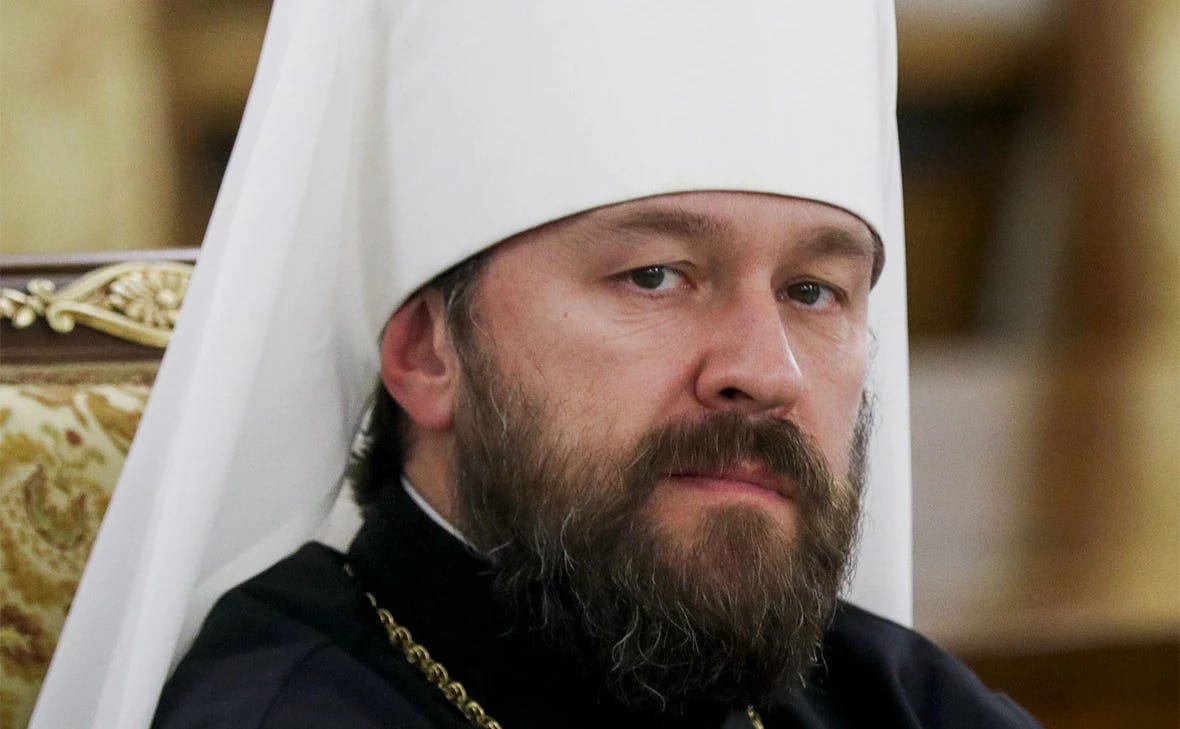
Фото: Михаил Терещенко / ТАСС
I spent the first two weeks of July in Rome, at the European Academy of Religion conference, and then in Berlin, meeting with Orthodox folks from different jurisdictions. One conversation kept recurring: “How could this possibly have happened to Metropolitan Hilarion, such a gifted theologian, the leading candidate for the patriarchal throne!” (I wrote in detail about what actually happened here). Knowing him personally was capital many people hoped to keep drawing on once Hilarion ascended the Moscow throne.
None of this sighing surprised me. I’d heard it all before. What struck me was the scale. The people voicing such tender sympathy for Hilarion weren’t naive laypeople who’d read too many church-related websites. These were bishops, priests, theologians: people whose job, among other things, is presumably to understand how power actually works inside the Russian Orthodox Church. And yet all of them had been naive beyond naive, living for years inside a well-crafted myth.
Hilarion was never ever a serious candidate for the patriarchal throne. Never. It was a bluff—a brazen, cynical one. For years his aides and the staff of the Department of External Church Relations sold this line to interlocutors across Russia, Europe, and America, in public statements and in whispers alike, counting precisely on that ignorance and admiration of the Russian Church.
Hilarion has one enormous problem, and it was an insurmountable obstacle to the patriarchate. He is catastrophically alone, pathologically so, I’d even say. Not for lack of contacts: he has dealt with hundreds, thousands of people, delivered speeches, acted as a diplomat, written books, conducted concerts.
But he was alone in the sense that, across his entire church career, he never wanted, or never managed, to build a single relationship of equals. Around him there were only subordinates he had raised up, who owed him everything and hung on his every word, or contacts held at a vast, carefully maintained distance. Friends, partners, people he reckoned with as equals: he never had any. He may not have been capable of it at all, not by accident of temperament, but by an inner constitution, a spiritual disposition, that treated the very idea of friendship as a threat. In Orthodox thought, to be a person is to exist in relation to other persons; being, as the old formula has it, is communion. It is hard to think of anyone who believed this less, in practice, than the man who spent decades explaining it, with great erudition, to audiences in the West.
The same bluff fed on a further confusion: direct access to the patriarch was mistaken for influence over the episcopate, though the two were relationships of an entirely different, even opposite, nature. The one visible exception to Hilarion’s general solitude was his closeness to Kirill, first as metropolitan, then as patriarch. But the exception confirms the diagnosis rather than refuting it. For Hilarion, that closeness was not only a source of career advancement but a deeply painful kind of relationship, in which the patriarch invariably played the strict, commanding father, and Hilarion himself was cast as the frightened, trembling son. Perfect love, St John tells us, casts out fear. Whatever bound these two men, it was not that. This was not friendship, not a partnership of equals: it was the same vertical structure, only transposed into the register of feeling.
A patriarch is elected by a sobor. Ideally, where the Church is free, this is an act of sobornost in its original, Afanasievan sense: not an administrative procedure but an assembly bound together by mutual trust among equals. Voting at a sobor has nothing to do with citation counts or international name recognition; it is, above all, an act of trust and hope. A bishop at a sobor votes for someone he has a personal relationship with, someone he respects. Building a faction at a sobor takes someone who has spent years investing in other people, not as pieces on a chessboard, but as people whose fate he actually cares about. Hilarion was never capable of that kind of engagement, and everyone who had even brief contact with him knew it perfectly well. Imagining a substantial bloc of bishops prepared to vote for him was impossible long before the unfortunate accidents of the past three years made it obvious to everyone else.
I really hope that those who spent years believing Hilarion was supposed to be the future patriarch (and, let’s be honest, counting on some dividend from that acquaintance) will finally take a sober look at how terribly power actually works in the Russian Church. There is something genuinely sad in a life built this way, though the sadness excuses nothing it enabled.
And forget the whole idea like a bad dream.
Unfortunately, this is an Orthodox problem. It is not unique to the Russian Orthodoxy or to Hilarion specifically. Power in Orthodoxy is and always has been a real and largely (though certainly not entirely) unrecognized problem. At the moment it is a significant issue in the Russian Church, as you detail in your book. Moreover, isolated bishops are everywhere. Some of the loneliest and most disaffected men I have known are Orthodox bishops. The system works it this way in the majority of cases. There are exceptions, to be sure; however, they are exceptions. Hilarion may well be a victim of character, as it were. Perhaps intensely introverted or even autistic; even so, that does not explain the extreme isolationism and individualism of anyone in such offices. The sad fact of the matter is that the episcopacy as we know it now is far removed from the interpersonal work of shepherding souls. It is hard to imagine an Orthodox bishop leaving the ninety-nine in search of the one wayward sheep. He is the pseudo-emperor now, not the shepherd deeply involved with his sheep. As a rule, the episcopacy is an administrative office and has lost its function of servant-leadership.
Relatedly, it occurred to me recently that your book could function well in catechism classes. Few things can temper Orthodox rhetoric better than Orthodox reality.
Do you know of anyone that could replace Kirill one day ? Obviously every bishop could but due the madness of Russia who really stands any chance ?